Forward biased

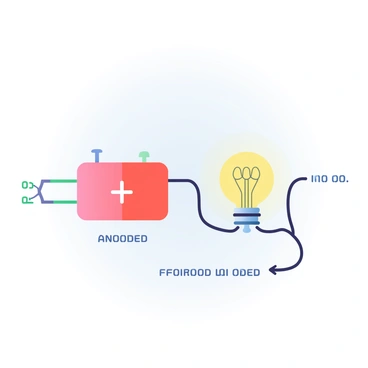
A detailed circuit board is displayed with a prominently placed forward-biased diode in the center. The diode is labeled with "Anode" and "Cathode" at its respective ends. Surrounding the diode are various electronic components, including resistors and capacitors, each with clearly visible labels. The circuit board itself has a green base color, with intricate copper traces connecting the components. There are small pads for soldering connections, and the overall layout of the board is organized and precise.A forward-biased diode is prominently displayed, showcasing its structure with a clear anode and cathode. The diode is connected in a simple electronic circuit, featuring a power source that is represented as a battery with positive and negative terminals. Wires connect the diode to the battery, illustrating the flow of current through the circuit. The diode's semiconductor material is visible, with the p-n junction highlighted. The circuit board has a clean layout with additional components such as a resistor next to the diode, completing the basic electronic setup.An illustration showcasing the "evolution of diodes" with a clear focus on "forward-biased technology." The image features various types of diodes lined up in chronological order, starting with the earliest models on the left, transitioning to more advanced designs on the right. Each diode is labeled with its name and the year it was developed. The background includes light, pastel-colored graphs and schematics that symbolize technological advancement. Arrows connect each diode, indicating the progression and improvements in technology. In the foreground, there are small spark symbols around the forward-biased diodes, emphasizing their function in circuits.A graph illustration displays the IV characteristics of a forward-biased diode. The x-axis is labeled "Voltage (V)" while the y-axis is labeled "Current (I)". The curve representing the diode's characteristics rises steeply after a certain threshold voltage, showing the rapid increase in current with a small increase in voltage. There are grid lines in the background to aid in reading values on the axes. The point where the curve begins to rise is clearly marked, indicating the turn-on voltage of the diode. Additional markers are present on the curve to highlight specific current values at various voltage points.A technical illustration featuring two distinct electronic components: a forward-biased diode on the left and an LED on the right. The forward-biased diode is depicted with a cylindrical body and two leads, showing a solid arrow indicating the direction of current flow. It has a simple design with a transparent casing, revealing its internal structure. The LED is illustrated beside it, showcasing its bulbous shape and vibrant colored lens. The image includes labels for each component, displaying "Forward-biased Diode" for the diode and "LED" for the LED. Arrows indicate the direction of current flow for both components, and dashed lines connect similar features, highlighting their operational similarities and differences. The background consists of a subtle grid pattern to enhance the technical aspect of the illustration.A close-up view of a diode, depicted in 3D, showcasing its internal structure. On the left side, the diode is in reverse-biased condition, with arrows indicating the flow of current away from the junction. The color of the anode is a lighter hue, while the cathode is a darker shade. On the right side, the diode transitions to a forward-biased condition, showing arrows directing the current flow towards the junction. The anode glows brightly, illustrating the flow of electricity, while the cathode remains dim. The background consists of a gradient transitioning from cool to warm colors, emphasizing the change in electrical conditions.An exploded view of a forward-biased diode is depicted, showcasing its internal components and materials. At the center, there is a semiconductor junction, clearly illustrating the p-type and n-type regions. Surrounding the junction, there are metallic electrodes labeled "anode" and "cathode," each with distinct shapes. Additionally, there are layers of insulation and packaging material surrounding the semiconductor, providing context to the structure. Sensitively detailed, the internal components include a small diode chip and bonding wires connecting to the electrodes. Each element is precisely arranged to emphasize the arrangement and functionality of the diode.A conceptual art piece depicting a forward-biased diode at the center, with an intricate network of glowing energy lines emanating from it. The diode is made of semi-transparent material, showcasing its internal components. Surrounding the diode, there are various small devices, such as sensors and circuit boards, that appear to be absorbing the radiant energy. The background features a soft gradient, enhancing the luminous effect of the energy flowing towards the devices. Bright, dynamic colors represent the energy transition, creating a visually striking representation of energy harvesting.A digital interface is shown displaying a virtual simulation of a forward-biased diode within an electronic circuit. The diode is represented with distinct anode and cathode markings. Connected to the diode are various circuit elements including resistors, capacitors, and a power source. The simulation features a graphical representation of current flowing through the diode, illustrated with directional arrows. Voltage levels and current readings are indicated on the interface, along with a grid background that outlines the circuit layout.A complex circuit diagram is displayed, featuring multiple forward-biased diodes. Each diode is represented with distinctive symbols, connected by lines indicating the flow of current. The diagram includes various nodes where the diodes intersect, as well as resistors and capacitors, providing context to their arrangement. Labels mark the components and directions of current flow, enhancing clarity. The overall design is intricate, showcasing a detailed network of electrical connections and components.A smartphone circuit board displayed with intricate details, featuring various components such as resistors and capacitors. In the center, there is a forward-biased diode, highlighted with a glowing effect to emphasize its role in the circuit. The diode has distinct markings and leads, connected to the circuit pathways. The background shows traces and connections that illustrate the complexity of the circuit, creating a dynamic and educational depiction of the smartphone's inner workings.A forward-biased diode is positioned in the center of the image, designed to resemble a delicate green leaf with intricate vein patterns detailed on its surface. Surrounding the diode are soft petals in various shades of pink and purple, creating a flower-like appearance. The background is a light gradient, transitioning from pale yellow at the top to soft green at the bottom. Tiny water droplets glisten on the leaf, and the petals appear slightly curled, adding depth. The scene captures the harmonious blend of technology and nature.An illustration of a forward-biased diode is displayed prominently in the center. The diode is represented with a triangle pointing towards a vertical line, indicating its direction of current flow. Arrows are shown emanating from the positive terminal of the voltage source and moving towards the anode of the diode, illustrating the flow of current. A simple circuit diagram surrounds the diode, featuring a resistor and a power source, with clear connections represented by straight lines. The schematic is clear and easy to understand, highlighting the components and their interactions.A close-up view of several advanced forward-biased diodes arranged neatly on a sleek, metallic circuit board. The diodes have a glossy, iridescent finish, reflecting various colors of light. Each diode has a distinctive shape, part of an intricate electronic design that includes multi-layered circuits and tiny, illuminated components. Small, glowing indicators near each diode show their operational status. Surrounding the diodes are intricate traces and pathways etched into the board, showcasing the complexity of next-generation electronics. The background features a soft gradient that enhances the futuristic atmosphere of the scene.A scientist in a laboratory is conducting experiments on forward-biased diodes. The scientist is wearing a white lab coat and safety goggles, focused on a detailed setup of test equipment on a workbench. Various scientific instruments, including a multimeter and an oscilloscope, are visible, displaying readings and graphs. The lab is filled with shelves of neatly organized electronic components, wires, and circuit boards. Bright overhead lights illuminate the workspace, creating a vibrant atmosphere for exploration and discovery.A forward-biased diode represented in a 3D render. The diode features a cylindrical shape with a metallic body and two leads extending from either side. The positive terminal is clearly marked with a "+" symbol, while the negative terminal has a "-" symbol. Light is shown passing through the diode, indicating its conductive state. The background is a neutral gradient to fully focus on the diode's details and structure.A simple circuit diagram featuring a forward-biased diode and a resistor connected in series. The diode is depicted with its anode connected to the positive terminal of a power source, and its cathode connected to one end of the resistor. The other end of the resistor connects back to the negative terminal of the power source, completing the circuit. The diode is marked with a clear arrow indicating the direction of conventional current flow. The resistor is represented with its standard symbol, emphasizing its role in limiting the current in the circuit. Annotations describe the voltage across the diode and the resistor, illustrating their interaction in the circuit.A clean diagram displays a forward-biased diode in action. The diode is represented with a symbol showing a triangle followed by a line. Flowing into the anode side of the diode, there is an arrow indicating the direction of the current. A voltage source is connected to the anode, showing positive polarity, while the cathode is connected to ground. The voltage level is noted next to the voltage source, with an indication of its positive value. Additionally, the current flow is illustrated with an arrow traveling through the circuit, from the anode to the cathode, demonstrating that the diode allows current to pass through in this configuration.A detailed schematic diagram of an electronic circuit featuring a forward-biased diode. The circuit includes a power source depicted on the left, connected to a resistor and the forward-biased diode, which is illustrated with its anode and cathode clearly marked. The circuit also contains additional components, such as a capacitor and an inductor, all accurately represented with distinct lines and symbols. Each component is clearly labeled with its respective value and type, ensuring easy identification for viewers. The layout is organized and well-structured for clarity.A technician with short black hair and wearing safety goggles is focused on testing a "forward-biased diode" using a "multimeter" in a well-organized workshop. The technician is dressed in a blue shirt and grey overalls, sitting at a wooden workbench covered with various electronic components and tools. The multimeter is positioned prominently in front of him, displaying numbers on its screen. Various color-coded wires are connected to the diode, and a small soldering iron is resting nearby. In the background, shelves filled with neatly arranged tools and components, including resistors and capacitors, create a functional atmosphere.An illustration features a forward-biased diode positioned prominently in the center. The diode has a red body with clear polarity markings indicating the anode and cathode ends. To the right of the diode, a small light bulb is connected by wires, glowing with a warm yellow light. The light bulb has a classic rounded shape with a transparent glass enclosure, showcasing the filament inside. Below the components, there are labeled arrows indicating the direction of current flow. The background is a soft gradient, transitioning from light blue at the top to white at the bottom, enhancing the focus on the diode and light bulb.An animated scene depicts a forward-biased diode. The diode is represented with clear markings indicating its anode and cathode. Around the diode, numerous small electrons, illustrated as circular shapes, are flowing in a specific direction towards the anode. This flow is emphasized with directional arrows, showing the movement of the electrons. The background features a simple grid pattern to illustrate the flow of current, with the electrons moving smoothly through the diode, creating a dynamic visual of electrical conduction.A diode symbol illustrated in a clear and precise manner, showing a triangle pointing towards a vertical line. The triangle represents the anode, while the vertical line signifies the cathode. There is an arrow indicating the direction of conventional current flow from the anode to the cathode. A forward-biased indication is included, depicted by a solid arrow and a positive voltage symbol near the anode. The overall design is clean, with labels for each component to enhance understanding.An infographic featuring a forward-biased diode that illustrates its functionality in regulating current flow. The diode is depicted at the center, clearly labeled with arrows indicating the direction of current. Surrounding the diode, there are graphical representations of voltage levels, showing how the diode allows current to pass once a specific voltage threshold is met. Additionally, there are labels and annotations explaining key components such as anode, cathode, and the characteristics of the forward bias condition. Color-coded sections highlight the difference between forward bias and reverse bias, enhancing the educational aspect of the infographic. A grid background aids in providing a structured visual layout for better understanding.A classroom scene shows students engaged in an experiment with forward-biased diodes. In the center of the room, a long wooden table is cluttered with laboratory equipment including multimeters, wires, and breadboards. Two students, one wearing glasses and a lab coat, are working together to connect the diodes to a power source. They are both focused on their task, with the student in glasses pointing at the setup. Behind them, a chalkboard displays diagrams of electrical circuits, and other students are seated at desks, observing the experiment. Sunlight streams in through a window, illuminating the various tools and papers scattered around the table.An array of various types of diodes arranged in a grid format, including forward-biased diodes prominently displayed. Each diode is represented with a clear label that annotates its features, such as "Zener Diode," "Schottky Diode," and "Light Emitting Diode" in bold, legible text. The diodes are illustrated with distinct colors and shapes to highlight their differences, such as a Zener diode with a unique symbol indicating its reverse voltage. The background is simple and unobtrusive, allowing the diodes and their annotations to stand out clearly.An overhead view of a table filled with various electronic components, including resistors, capacitors, an integrated circuit, and a forward-biased diode prominently placed in the center. The diode is highlighted with red and black colors, showing its distinct shape and leads. The table surface is a light wooden texture, and there are small tools such as a screwdriver and wire cutter placed nearby. The components are organized neatly and some are labeled with small tags for identification.A circuit board layout is displayed with a forward-biased diode positioned correctly. The diode is shown with its anode and cathode leads clearly marked. The anode, indicated with a "+" symbol, connects to the positive side of the circuit, while the cathode, marked with a line, connects to the negative side. Surrounding the diode are traces illustrating the flow of current. Additional components, such as resistors and capacitors, are positioned nearby to show their relationship in the circuit. Labels and arrows indicate the direction of current flow and the significance of proper orientation for the diode.
コミュニティ内で何も見つかりませんでした