Formed elements

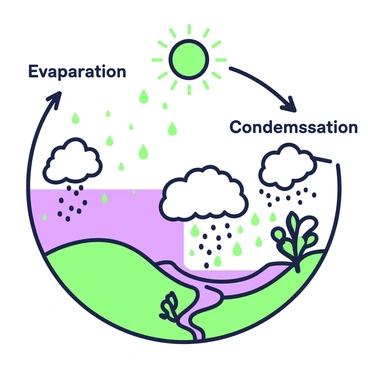
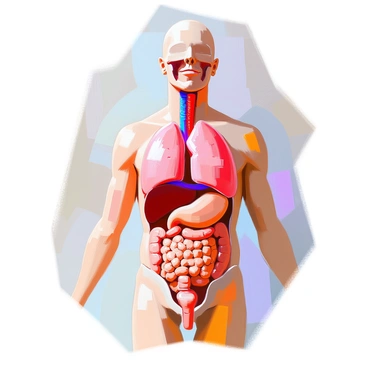
A night sky filled with numerous stars scattered across a dark background. Prominent constellations are clearly defined, each composed of stars connected by lines. The constellations include "Orion," depicted with his distinctive belt, "Ursa Major," represented by the famous Big Dipper shape, and "Cassiopeia," characterized by her W-shape. Each constellation is labeled with its name in clear, bold text, positioned near the corresponding star formations. The scene conveys an expansive view of the cosmos, with star clusters twinkling amidst the outlined constellations.An illustration of the water cycle is displayed prominently. At the top, "Evaporation" is labeled, featuring the sun emitting rays onto a body of water, with small droplets rising into the air. Below this, the next stage is labeled "Condensation," showcasing clouds forming in the sky as the droplets gather. Further down, "Precipitation" is indicated, with raindrops falling from the clouds back to the ground. The ground is depicted with plants and a small stream, illustrating the cycle returning to the starting point. Each stage is clearly delineated and labeled for clarity.An illustration of a forest ecosystem filled with diverse vegetation and wildlife. The foreground showcases a large green tree with broad leaves and a thick trunk, next to which is a cluster of colorful wildflowers. Scattered throughout the scene are various smaller bushes and ferns. In the midground, a deer can be seen grazing next to a small stream, while a bird perches on a branch above. On the ground, several insects like butterflies and beetles are visible. Each plant and animal species is presented with a label beside it for identification.An illustration of the solar system displaying a vibrant arrangement of planets in their respective orbits around a large, glowing sun at the center. The sun emits bright rays, illuminating the entire scene. Each planet is distinctly represented with accurate colors and sizes. "Mercury" is the closest to the sun, followed by "Venus" with a yellowish hue, "Earth" featuring blue oceans and green landmasses, and "Mars" with its reddish surface. Further out, "Jupiter" is depicted with its characteristic bands and a prominent storm, while "Saturn" showcases its iconic rings. "Uranus" appears with a blue tint, and "Neptune" is shown as a deep blue planet. Each planet is clearly labeled with its name in a legible font, arranged along their orbits.An illustration of a tropical rainforest biome, showcasing a vibrant scene filled with diverse flora and fauna. Tall, lush green trees with broad leaves stretch towards the sky, interspersed with colorful orchids and ferns on the forest floor. Vines and lianas drape down from the branches, creating a sense of depth and richness. Various animals are depicted, including a bright blue macaw perched on a branch, a jaguar stealthily moving through the undergrowth, and a tree frog resting on a leaf. Each plant and animal is clearly labeled, providing a detailed guide to the biodiversity of this ecosystem.A diagram of an atom featuring a central nucleus surrounded by orbiting electrons. The nucleus contains clusters of protons and neutrons, clearly distinguished from each other. Each proton is represented as a small sphere, while each neutron is also depicted as a small sphere, both clustered tightly in the center. The electrons are illustrated as smaller spheres encircling the nucleus in distinct orbits. Labeled parts include "protons," "neutrons," and "electrons," with arrows pointing from the labels to their corresponding components within the diagram. The overall color scheme is composed of gradient pastel colors.A detailed illustration of the human heart featuring clear labels. The heart is depicted with its four chambers: "right atrium," "right ventricle," "left atrium," and "left ventricle." Each chamber is distinctly outlined and numbered. The major valves are illustrated, including the "tricuspid valve," "pulmonary valve," "mitral valve," and "aortic valve." Arrows indicate the flow of blood through the heart's chambers and valves, enhancing the understanding of its function. The overall composition is organized and informative, making it suitable for educational purposes.A detailed diagram of an animal cell is displayed prominently. The cell membrane is clearly outlined, surrounding the cell's structures. Inside the cell, the nucleus is visible at the center, labeled clearly. The cytoplasm is filled with various organelles, including mitochondria, which are oval-shaped with inner folds, and endoplasmic reticulum, appearing as a network of tubes. Ribosomes are shown as small dots scattered throughout the cytoplasm. The Golgi apparatus is depicted as a stack of flattened sacs, labeled accordingly. Lysosomes are represented as small circles, and the cell's centrioles are arranged in pairs near the nucleus. Each organelle is distinctly labeled with clear text indicating its name.An educational illustration depicting the photosynthesis process. The image is divided into distinct sections for each stage of the process. The first section shows "sunlight" shining down on green leaves, which are prominently featured. The second section illustrates "water" being absorbed by roots from the soil. The third section depicts "carbon dioxide" entering the leaves through small openings called stomata. The fourth section visually represents the process of "glucose" production within the leaves, with arrows indicating the transformation. The final section shows "oxygen" being released back into the atmosphere. Each stage is clearly labeled with text surrounding the visual elements, creating a coherent flow of information.A detailed botanical illustration depicting a flower with clearly labeled parts. The flower features vibrant petals in shades of pink and purple, with delicate textures visible. The center of the flower showcases the pistil, surrounded by numerous stamens with fine filaments. Each part, including the sepals, petals, stamens, and pistil, is marked with precise labels in elegant script. The composition is set against a subtle background that enhances the clarity of the flower's details and labels.An educational diagram of a plant cell is displayed, featuring a clear outline of the cell structure. The cell wall is visible surrounding the cell, depicted in a detailed manner. The nucleus is located near the center, prominently labeled. Several chloroplasts are scattered within the cell, each also labeled, illustrating their distinct shapes. Other parts of the cell, such as the vacuole and cell membrane, are included and labeled correctly. The diagram is organized to emphasize each component of the plant cell with clarity.An illustration of a human brain displayed in a lateral view, with clear labels indicating the different parts. The outer layer, referred to as the "cortex," is prominently outlined. The "cerebellum" is shown at the lower back of the brain, distinctly marked. Additional labeled parts include the "brainstem" and "hippocampus," all presented in a detailed, structured manner, emphasizing the complexity of the brain's anatomy.A close-up illustration of an insect displayed on a light surface. The insect is shown in a side view, highlighting its detailed anatomy. Its "antennae" are long and segmented, protruding from its head. The "wings" are spread open, showcasing intricate vein patterns. The "legs" are elongated and jointed, with tiny hooks at the end. Each body part is clearly labeled with arrows pointing to them, including the "thorax," "abdomen," and "compound eyes." The overall composition emphasizes the insect's structure and features.A detailed labeled diagram of the human skeleton, showcasing the structure and major bones. The skeleton is positioned centrally, with the "femur" highlighted prominently in the upper thigh area and the "ribcage" clearly marked surrounding the chest area. Other major bones such as the "skull," "spine," and "humerus" are also included, each with distinct labels pointing to their respective locations. The diagram is designed to provide clear visibility of the bones and their names for educational purposes.A modern pastel illustration of a fish with its body parts clearly labeled. The fish is oriented horizontally, showcasing its streamlined body. Each part is marked with clear, bold text: "Fins" are labeled on the dorsal, pectoral, and caudal fins, while "Gills" are highlighted behind the head. The background features soft, flowing waves to enhance the aquatic theme.An illustration of the phases of the moon displayed in a circular arrangement. Each phase is represented, including the new moon, waxing crescent, first quarter, waxing gibbous, full moon, waning gibbous, last quarter, and waning crescent. Each phase is surrounded by a soft gradient of pastel colors. Each moon phase is labeled with the corresponding names in a clear, elegant typeface. The background gently complements the moon phases with subtle gradient hues.A bacterial cell is depicted with a clear outline, showcasing its various components. The cell wall is prominently labeled and surrounds the entire cell structure. Emerging from the cell are multiple flagella, also labeled, illustrating their role in movement. Inside the cell, there are labeled components such as ribosomes and DNA, represented as small dots and strands. The background features a gradient of pastel colors to enhance the visual appeal of the illustration.A dinosaur skeleton is positioned in a museum setting, displayed prominently on a pedestal. Each bone of the skeleton is clearly visible and has a label next to it indicating its name. The skull, vertebrae, ribs, and limbs are all meticulously defined. The labels are written in clear letters, placed directly next to each bone for easy reading. The backdrop features subtle museum lighting and a faint outline of other exhibits in the distance, enhancing the focus on the skeleton.A botanical illustration of a single green leaf, displayed prominently in the center of the image. The leaf is detailed, showcasing its intricate internal structure, including visible veins that branch throughout the leaf. The epidermis is highlighted, demonstrating its protective role. Each part of the leaf is labeled clearly, with arrows pointing to specific features such as "veins" and "epidermis." The background is a soft, neutral color to enhance the focus on the leaf and its details.An illustration of the ocean food chain is displayed, starting with "plankton" at the bottom. Above plankton, there is a variety of "small fish" that are illustrated swimming in the water. Next, a larger fish, labeled as "tuna", is depicted above the small fish. Following the tuna, a "seal" is portrayed, leaping out of the water. At the top of the food chain, a "shark" is illustrated, majestically swimming. Each element is clearly labeled and connected with arrows to indicate the flow of energy in the ocean ecosystem. The background features gradient pastel colors, creating a calm underwater atmosphere.A simple circuit diagram is displayed, featuring clear and labeled components. In the center, there is a battery with a positive and negative terminal marked. A resistor is connected to the battery, shown with its label clearly identifying its resistance value. There are wires linking the battery to the resistor, depicted as straight lines. Additional elements include a switch positioned in the circuit, labeled accordingly, and a light bulb also connected to demonstrate the flow of current, with labels indicating its wattage. The entire arrangement is organized in an easy-to-understand layout.A detailed diagram illustrating the process of fossil formation is depicted. The first step shows "organisms" such as fish and plants in a shallow body of water, becoming buried in sediment. The second step is labeled "sedimentation," where layers of soil and mud accumulate on top of the remains. The third step displays "compaction," showing the layers being pressed together over time. The fourth step is marked "mineralization," illustrating how minerals infiltrate the remains, preserving their structure. The final labeled step shows "exhumation," where fossils are exposed on the surface due to erosion. Each step is clearly defined with arrows connecting them in a logical sequence.A geological diagram displaying sedimentary rock layers arranged horizontally. The diagram features several distinct layers, each with varying textures and patterns representing different types of sedimentary rocks. Each layer is clearly labeled with text that includes terms such as "sandstone," "limestone," and "shale." The layers are stacked one on top of the other, illustrating the order of deposition. The background of the diagram is minimal to emphasize the rock layers and their labels.An illustration of a cross-section of a fruit, showcasing the inner parts clearly. The fruit is round and has a vibrant color, with a smooth surface. The interior reveals the "pulp," which is thick and juicy, with a rich texture. The "seed" is nestled in the center, showing its shape and details. Each part is labeled with clear, bold text to indicate "seed" and "pulp." The background features a subtle gradient of pastel colors to enhance the visual presentation.A detailed diagram illustrating the human muscle groups, prominently featuring the "biceps" located on the upper arm and the "quadriceps" situated on the front of the thigh. The diagram is structured to clearly show the separation of each muscle group with precise labels. Additional labeled muscles include "triceps," "deltoids," "hamstrings," and "calves," each distinctly identified. The muscle groups are color-coded for clarity, allowing for easy differentiation between the various areas of the body. The overall layout is organized, ensuring that all muscles are proportionately depicted and clearly visible.An illustration depicting the butterfly life cycle stages, arranged sequentially from left to right. The first stage shows an "egg" on a green leaf, with tiny details of the egg's texture. The next stage presents a "caterpillar" or larva, featuring a green and black striped body, crawling on the leaf. The third stage is the "chrysalis," suspended from a branch, showcasing its shiny green surface with gold accents. The final stage reveals an "adult butterfly" with open wings, displaying vibrant patterns in shades of orange, black, and blue. Each stage is clearly labeled with its corresponding name in elegant font below the image.An illustration of the human body, displayed in a frontal view, showcasing the internal organs with clear labels. The body is anatomically accurate, with prominent features such as the "liver" colored in a deep shade and located in the upper right abdomen. The "lungs" are depicted on either side of the chest, highlighted in a light color, showing their distinct structure. Other internal organs are also labeled, such as the "heart" in the center of the chest, and the "stomach" below the rib cage. The spinal column runs down the back, providing a complete view of the body's structure.A detailed illustration depicting a mountain range in various stages of formation. The image includes layers of sedimentary rock being uplifted. There are arrows indicating tectonic plate movement beneath the surface. "Erosion" is labeled on areas where rock material has been worn away, while "Volcanic Activity" is shown with a volcano erupting, dispersing ash and lava. The label "Weathering" is positioned near rocks that are crumbling and breaking apart. Each geological process is clearly labeled with bold text.
コミュニティ内で何も見つかりませんでした